Showing posts with label comet. Show all posts
Wednesday, November 27, 2013
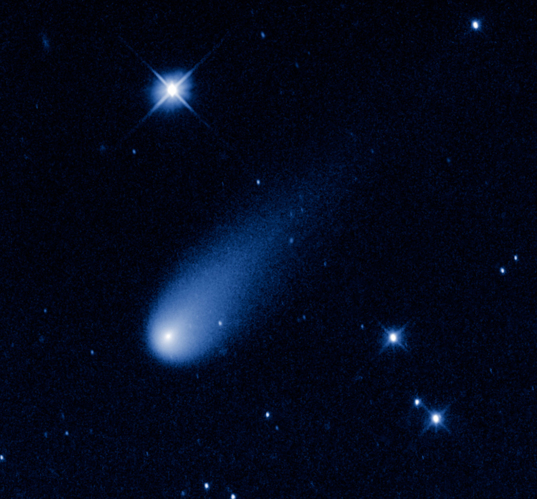
Comet ISON: Your Half-time Report
I sit writing this at 38,000 feet as I head out to Kitt Peak to join my fellow CIOC-ers Matthew and Casey for perihelion observations of Comet ISON, and I find myself having an early moment of reflection.SOURCE: http://www.planetary.org/blogs/guest-blogs/2013/1126-comet-ison-your-half-time-report.html
When I first heard about comet ISON and its sungrazing orbit in September 2012, I though, "this sounds promising, but there's a long time between now and perihelion, and anything could happen. I'm not going to get excited over this one just yet." In January 2013 I found myself at a meeting in Washington DC in which ISON was discussed and the representative from NASA Headquarters recommended that maybe the science community orchestrate an observing campaign centered on the comet. Having lived through a similar event before with the observing campaign to support the NASA Deep Impact mission, Dr. Casey Lisse volunteered to lead the effort and immediately tapped a couple of attendees on the shoulder, myself included, to join the Campaign team.
I've never been involved in something like this, so I really wasn't certain what to expect of the Campaign or of the comet. What has unfolded is simply beyond any expectation I could ever have had.
UPDATE: http://www.space.com/23591-comet-ison-visibility-naked-eye.html
Wednesday, March 6, 2013
Comet to Make Close Flyby of Red Planet in October 2014
Comet 2013 A1 (Siding Spring) will make a very close approach to Mars in October 2014.
The latest trajectory of comet 2013 A1 (Siding Spring) generated by the Near-Earth Object Program Office at NASA's Jet Propulsion Laboratory in Pasadena, Calif., indicates the comet will pass within 186,000 miles (300,000 kilometers) of Mars and there is a strong possibility that it might pass much closer. The NEO Program Office's current estimate based on observations through March 1, 2013, has it passing about 31,000 miles (50,000 kilometers) from the Red Planet's surface. That distance is about two-and-a-half times that of the orbit of outermost moon, Deimos.
Source and Read more: http://www.nasa.gov/mission_pages/asteroids/news/comet20130305.html
Wednesday, February 27, 2013
Comet C/2013 A1 and Mars in 2014
Discovery News
A recently discovered comet will make an uncomfortably close planetary flyby next year — but this time it’s not Earth that’s in the crosshairs.
According to preliminary orbital prediction models, comet C/2013 A1 will buzz by Mars on Oct. 19, 2014. The icy interloper is thought to originate from the Oort Cloud — a hypothetical region surrounding the solar system containing countless billions of cometary nuclei that were outcast from the primordial solar system billions of years ago.
We know that comets have hit the planets before (re: the massive Comet Shoemaker–Levy 9that crashed into Jupiter in 1994), Mars in particular. It’s also believed that Earth’s oceans were created by water delivered by comets — cometary impacts are an inevitable part of living in this cosmic ecosystem.
Raw Story
Astronomers say that a comet will make an close flyby next year, not of Earth, but of our neighbor planet, Mars. According to a Monday report on Discovery.com, the recently discovered comet, named C/2013 A1 will fly close to Mars on Oct. 19 of 2014.
Comets are balls of ice and debris flung off in the process of forming planets and stars. Comet c/2013 is believed, like many others that pass through our solar system, to have originated in what is known as the Oort Cloud. The Oort Cloud is a massive field of many billions of comets that surrounds our solar system. The cloud was theorized by astronomer Jan Oort in 1950, but it has never been seen and scientists, while mostly accepting that it exists, argue about its size and where the comet nuclei floating in it came from.
Subscribe to:
Posts (Atom)